A Greater Righteousness
In 1994 there was a movie about the death of Beethoven. How at the end of his life a letter was found written by the composer to someone he called his "immortal beloved." The movie seeks to answer who is this "immortal beloved?" To answer this the film traces Beethoven's life from his tragic childhood to his meteoric rise as a composer, and to the second tragedy: he went deaf. Yet as they search for his "immortal beloved" the movie really begs another question: how could the greatest of musical compositions, the 9th symphony, how could Beethoven create this when he was deaf and bitter? Even more how could this piece of music conclude with the Ode to Joy?
Amazing question. As the movie has been available for viewing for more than 30 years, I won’t balk at giving away the ending. In the end the movie suggests the answer to the question about the Ode to Joy is found in a moment of his childhood. As a young boy he was beaten and abused by his father. One night he left, ran. Running from abuse, running free of fear, Beethoven dives into water. Floating on his back, held aloft by the lake, he sees the stars above him. In this moment Beethoven hears the 9th symphony in the water and the starlight. Hence at the end of life unable to hear sound, he could still hear memory.
I cannot compose music. Barely find a radio station if they still exist. But I do know memories born of silky water in a lake at night. I do know memories conjured by such water. How they lift you, take you to a place beyond fear, an eternal place where you are on a celestial shore. I remember how twilight, how the lake engrafts you, buoys you, gives a glimpse of the garden of God, "Elysium." Remembering can be a place beyond fear.
In 1996 Diana's brain wasn't working. Her brain was clogged up. Doctors put in a shunt to drain fluid so her brain would not swell, be damaged.
I sat with Diana after her surgery. Head bandaged, she looked a bit worse for wear. But she was alert and alive. This was the most important part of the day: she was alive; she made it through.
Her husband Larry was not there. I made a joke about Larry being off negotiating the cost of the surgery. He was easily the cheapest person you will ever know in life. Sweet guy, but really cheap. We considered the possibility of Larry negotiating. He would be asking to see an itemized bill, a rationale for every charge, a question to raise with every vendor and machine.
On and on our imagining of Larry’s haggling went. Each time Diana laughed a bit more because Larry was very cheap and there was a plausible savings to be found. We could see him some place in the hospital arguing about the bill. We were laughing so much a nurse came in and chastised us. "She just had brain surgery. She needs to be still and calm. She cannot be laughing."
We both were silenced by the rebuke. But then Larry came in and we both burst into laughter. Larry wanted to know what was so funny. We laughed harder still. We laughed so much more the nurse returned to silence us.
Diana is alive. The shunt worked. Larry died in 2019 after a long life with his wife who laughed with me after brain surgery. The laughter in the hospital room imagining Larry haggling proved uneventful, yet potentially helpful.
In the moment of laughter Diana and I were in a place beyond fear. She could die at any moment. But she was loved. She could have died on the table. But her life was good. In the thirty years since the moment we laughed in her hospital room I am fully convinced Diana had fears, worries, dread even. But I am just as fully convinced in each moment of worry she knew there was a place beyond fear.
Wendell Berry died this week. A poet of farm and field, lake and woods. If you know of him, you most likely grew to cherish his humility, how he was of the earth, of the soil. He was the American poet of creation. If you know him the words he wrote of wild things were a reminiscing comfort these last few days. If you have never heard of him count this moment as a great gift, an invitation for remedy.
He wrote:
When despair for the world grows in me
and I wake in the night at the least sound
in fear of what my life and my children’s lives may be,
I go and lie down where the wood drake
rests in his beauty on the water, and the great heron feeds.
I come into the peace of wild things
who do not tax their lives with forethought
of grief. I come into the presence of still water.
And I feel above me the day-blind stars
waiting with their light. For a time
I rest in the grace of the world, and am free.
The day-blind stars waiting with their light. So much hope. Such a place of hope is only found beyond fear. Not fears dismissed or demeaned or ridiculed; a place beyond dread does not suppress or repress or deny. Heed the beginning of the poem, it begins in fear. But then, it moves beyond.
The place beyond fear listens to the sound of a child's dreams and slumbers and gasps at the remote possibility of suffering and clinches with painful acknowledgment: all our lives end. What will become of us? The listening, the honesty, the fragile nature of a child's breath, can take our breath away if we do not seek the peace of wild things.
The peace of wild things, the place beyond fear, has no cavalier rebuke of forced silence. The place beyond worry seeks the beauty of water where "the great heron feeds." The place beyond fear is a moment, a grace, we can all find if we seek it in still water.
In 1997, I remember saying to Kathy, we need to tithe. Give ten percent of our salary. This was a ridiculous idea. Five children, one salary, a mortgage and no prospects of a cash windfall. Tithing was ridiculous.
I remember her look, her eyes. Why would we make such a step? Why would we do this? Sacrifice?
I said, we need to be generous. We need to live without guilt about giving. How can we ask others to give as an act of faith if we give in fear?
There was a long pause.
Three years later we found the place beyond fear. Lots of other fears and worries and concerns were still there. It wasn't magic or an alternative reality. It was freedom. We found the place of freedom.
We found the place beyond fear of money, and it was freedom. Again, finding this doesn't mean there is no fear in life, a kind of belligerence, fearlessness where you are reckless. Sometimes tragedy can strip away all meaning and fear no longer has the power of consequence. This was not the freedom we found beyond fear.
The place beyond fear was a moment, a breath, a lovely afternoon where we realized how many more challenges there are in life. Freedom was found in this moment: "money was not our fear." Lots of challenges yet to face in life, but this one was done. There is a place beyond fear.
Remembering can take you there.
Yet, when you worry about power, when authority is a question, if God on your side concerns you, you no longer remember there is a place beyond fear.
There is a place beyond fear; there is—a place where love is never wrong, but your love is given without demand, a place
where you are never wrong to hope, because your hope has no expectation; a place where you can trust because your trust is not a lie conjured to conceal falsity.
In this place beyond fear, love is given without a receipt,
hope grasped without control, faith a trust willing to be betrayed. We cannot find this place with certainty, nor without risk; this is not a conclusion. This memory is a beginning, an eternal embrace found in still water with wild things beyond the garden’s gate.
I don't know what your fear is. I don't mean to suggest it is wrong or without value. Like you I gasp when tragedy is considered. I have watched my children sleep and dream and needed to catch my breath so fear does not steal my love. Like you I wring my hands fearing the worst. Yet like you I must believe day-blind stars illumine me.
There is a place beyond worry. We can find it.
What grounds me, encourages me, causes wonder so I ponder is this: all the parables, all the miracles, all the questions and even the disputes of Jesus, all his life point to a freedom beyond fear. If you believe Jesus, trust him, not without doubt, but trust him as a true friend, you can find freedom. Freedom is the place where you no longer demand, require certainty. Your righteousness is joy, a greater righteousness.
Who gave you the authority to speak this way? Who put you in charge? Jesus responds to the question with a question. Was John the voice of God or just a voice amongst others? Must we listen to him because he is the way beyond fear or must we challenge him as a fearful voice like the rest?
Jesus is asking them: have you found the place beyond fear, do you remember where the great heron feeds? Do you know the water holding you aloft in the embrace of joy? Can you laugh at the edge of life?
The answer the Pharisees give, or don't give, is telling. They were afraid. They couldn't answer because of fear. They were tangled in cords of cowardice far from the place of freedom.
I have only one hope when we baptize a child. Only one.
My hope for Finn is he will find his way back to the place beyond fear. Regain, restore, redeem the memory of baptismal water, still water, the silky water at twilight before the warmth is gone. After becoming a man, I hope he will become free. Your love given without receipt, your hope sustained without demand of control, your trust of how life is not easy, this will become the memory restoring freedom. This I hope for him.
You and I have lots of fears. There is a lot we dread. Mostly what concerns us is our own failures, faults, misdeeds. The sum of our fears is most often the sum of our misgivings about ourselves. This is true.
I believe we can make our way back to the place beyond fear. Every teaching of Jesus, every miracle, every confrontation and parable, every healing, they are like a marker on the road, a sign saying go this way to freedom. You can make it. There is a place beyond fear; you can find it.
Give no truck to abusive power.
Honor no authority beyond freedom.
Come beside God who takes no side.
You can find this “place of wild things,”
a place where memory and love commingle
with no demand except joy.
Be willing to be absolutely wrong.
Untangle your heart of expectation, cords of distrust.
Be free of fearful lies—leave them aside.
Love without a receipt.
Hope without control.
Have faith willing to be betrayed.
There is a place beyond fear; there is—
a beginning, eternal embrace,
beyond the angels guarding the garden.
Hunger for the place heron feed.
Seek a greater righteousness in “day-blind starlight.”
You can find it. Believe me. Amen.
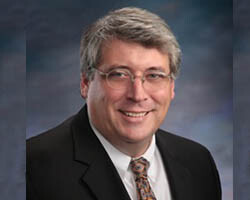
Rev. Dr. Fred G. Garry
Senior Pastor & Head of Staff
Sermon Notes
You can add your own personal sermon notes along the way. When you're finished, you'll be able to email or download your notes.