All of Them Are Alive
Give me a second. This will take a minute. Do you have an hour? This is our time; this is your day; we have all the time in the world.
I live not far from where I work. The walk from my office to the manse is maybe five minutes. Yet, when I get a text from my wife saying "lunch?" or "when are you coming home?" I answer in two ways, I say, "I am coming now" or "I be there in five minutes." "I am coming now" is code for 10-30 minutes; the second is a mystery, could be an hour, two, maybe more. Five minutes means I am not done with something, and this renders time amorphous.
Western culture loves to be on time, but so do some Asian cultures. The idea of JIT, just in time for industry comes from a great value of being on time but also timing. Not too early, not too late, just in time. There is a wonderful book about this called The Geography of Time. Some cultures are notorious for being late, starting late. I grew up hearing the word "manyana." I heard this a lot. Manyana in Spanglish means we will get to that later. Manyana
Yet, the one culture discussed in The Geography of Time where I found myself at a loss was Brazilian. The fascinating thing about Brazilian time is how everyone has their own, time that is. No one sets their watch to a standard. If we were to go around the sanctuary, compare our watches, they would all be within a few minutes of each other. In Brazil you would be hard pressed to find any two the same. You set it to your time. Hence, I have a class at 10:00 could mean 10:15 to someone else, 10:30 to another, maybe 9:50. Who knows? 10:00 is your 10:00. You arrive on your time. If such an idea hurts your head welcome to living cross culturally.
The summer we lived in Malawi dinner time was tough. On prior visits dinner time was a challenge, but in 2008 with our children, the idea of dinner time being imprecise, well, this was a struggle. To say come to dinner at 6:00 could mean we will have dinner at 6:30, 7:00, 7:30, 8:00. The rule in Malawi is you don't kill the chicken until all the guests arrived, meaning, you don't start your meal prep until you know the meal is happening. Explaining this timeframe to an eight-year-old, not easy.
Recently I attended the lovely celebration of 50 years of marriage for Claartja and Yunus. Lovely party, quite the celebration of family, generations, of course, spicy fish especially the anchovies and peanut dish. Fantastic. But when I arrived at the time I was told to arrive I knew this was way too early. Norma Tambingon said, "oh no pastor Fred, you come back in hour maybe." I was on time, but my time is not Indonesian. Not my first Indonesian service so I just smiled and returned to reading a novel.
I am not sure what the impact of smart phones will be on time. They set themselves so Brazil must be quite a mess; no one can simply choose their own time now. I saw no difference made by smart phones in Malawi as guests still arrive when guests arrive.
A controversial time is our day-light-saving adjustment. I have heard people say, you can't control time, the earth spins as it spins. This is true. Time marches on. We are just beginning to recognize, though, how we measure days is not as controlled as we think. Recently scholars adjusted the zodiac calendar of star signs for astrology noting how the days and weeks and months used to suggest a person's alignment with the cosmos, this calendar was never updated and thus all the signs were out of whack. Time is moving at its own pace, changing. After the adjustment, I went from being a Taurus to a Leo, something my children found much more fitting.
The Rolling Stones sang, Time is on my side; yes, it is. Yet, Mick Jagger is 83 and Keith Richards is now 82. Not sure time is on their side anymore. Something about living past life expectancy. Time is running backward Bob Dylan claims. A bit like the sands of an hourglass or the Arab belief about the length of life, how much time God gives to each of us. In Arab culture, God grants each person a certain number of breaths. We are ever running out of time.
Yet, the one reflection on time I treasure most is the work of a rabbi, Abraham Heschel in his book Sabbath. Here the day of rest is more than a day of the week. With Heschel the sabbath is an elegant presence, a wise, elusive spirit, beautiful way of living where your time and God's time come together. It is almost as if the first six days of creation only find their true meaning on the seventh. The work didn't stop on the sixth day, the work found completion in the shabbat, a splendid creation of God.
Reading Heschel's Sabbath it was as if time became a vision of life, recalibration, renewal. Not so much stopping of work, but a beginning of rest. What the writer of Ecclesiastes called our "anxious toil" ever so meaningless, this work could be laid aside for wisdom, contemplation. In the same way I love the Jewish tradition of stopping the clocks when a loved one dies. Time must stop for eternity.
Calendars, timers, watches, sundials, even the equinox of this week, all these measure chronologies, bring order to our sense of time. Whenever we seek order, we are prone to assert control. We need to make sense of when and where, but almost like clockwork, this sense of when and where becomes determination, force, ownership, domination. Don't waste my time. We have all arrived two minutes late and watched the shopkeeper shrugged their shoulders. You're too late; closed.
Yet, all this is just one sense of time. There is another whole other sense, the eternal, resurrected time, time and of the risen kingdom. This is different from chronological time. Eternal time, God's time, is not the same as ours. Chronological time is what the Sadducees are asking about, how does chronological time work in the resurrection, how do the dead keep time?
Jesus' response to the Sadducees says in God's time there is no living and dead, there is only living. Jesus says, to God all of them are alive. A different way of being, a different way of living when we transcend chronological time, when we are no longer bound by the earth, by flesh. He says in this Kingdom people cannot die anymore.
This is the lesson of the burning bush, the fire does not consume, destroy. God speaks from the burning bush to Moses and says, I am the God of Abraham, Isaac, and Jacob. I am the God of the living. For God they are all alive. This view of eternal time is spoken as a comfort to sorrow. Young Brad Keller spoke of his father as reunited with his mother, with Wendy. We speak of the image of being called by name, believing those who have died in this time are resurrected in God’s time. We speak of entering this place beyond, gathered to eternal life. Emily Dickinson called it home, heaven is a place where you don’t mind your dress, because you don’t mind your dress when you are going home.
There are so many beautiful images of eternal life. The great gittin-up morning. The Jordan across the deep river. A celestial shore, Valhalla, Elysium. Yet, what I find most intriguing in the gospels is how Jesus speaks of eternal time not as far off or in the by and by, eternal time is here and now; the Kingdom of God is near, in you, now. Eternal life is beyond us as a promise of heaven, but eternal time is the great balance of chronological time.
This is the great message of the Gothic Cathedral. The balance of eternal time and chronological time is in every pointed arch, every swirl of tracery, the colonnades. You can see it on your bulletin cover. The two circles in harmony whose union creates the pointed arch of the windows and aisles. Once you know what you are looking at, the Gothic Cathedral becomes an embodied image of heaven and earth, chronological and eternal not as one after the other, or one opposed to the other, but their union, harmony, perfect balance. Eternal life awaits us, but eternal time is here and now.
This was the guiding principle of the Gothic design, what each generation could take up, build, one after the next. It wasn’t a sensibility, a taste, style. It was the geometry of time in balance and harmony. We can live in chronological time and eternal time together. This is the great witness, doctrine, belief when we say Jesus is both fully human and fully God. A balance in harmony not contradiction.
This may feel a little esoteric. We are knee deep in philosophy here. Yet it does not need to be elusive, arcane or rarified air. You know eternal time and chronological time in the beauty of the sunset and sunrise. You can see it the waxing and waning of the moon. You can imagine the balance in the immensity and proximity of the milky way. You can see it when two people who love each other become one life together. You can see this in the coming and going of generations.
The balance is seen in the Lord’s prayer: hallowed be thy name, thy kingdom come thy will be done on earth as it is in heaven. The kingdom comes here; God’s will is here on earth as it is heaven. Not one or the other, both. We pray this balance each Sunday. Our earthly life and our eternal life may be seen as different, but eternal time and chronological time are held together. For God they are all alive.
This was the great take away for me from the centuries of Gothic buildings. It wasn’t the rose window or the colonnades or the ribbed vaults or the stained glass or flying buttress; it wasn’t even the pointed arched window. It was how each of these was a purposeful creation. They built a space of prayer as a prayer. The balance of time, the balance of two circles in harmony, this is not only geometry, but also prayer become geometry. By entering the space you are drawn upward into the prayer: on earth as it is in heaven. A place where all are alive.
You and I are very mindful of chronological time. We all are aware of eternal time as we are eternal life. Who here has no hope of heaven, no longing for reunion, no solace found in those we lost are found in God’s love? The great challenge, what all the teachings of Jesus point to, is how we can gain, find, see how eternal time is here and now. We can see what is eternal as we look to what is good and true and beautiful. Who has not felt eternal time in the bliss of joy, the grandeur of love where we lifted from the mundane and then set back down again? We may not build a Gothic Cathedral, but we must build a place where we enter the geometry of prayer, where our souls are brought into harmony with the Spirit of God.
This is the place where we gain the vision “they are all alive”. God sees us all, all of the time. A perfect harmony. Let make something beautiful, something good, true here. Let our hearts find rest here, harmony. Let the kingdom be here on earth as it is in heaven. Amen.
Speaker: Rev. Dr. Fred G. Garry
September 27, 2026
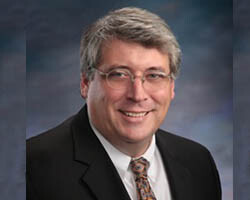
Rev. Dr. Fred G. Garry
Senior Pastor & Head of Staff
Sermon Notes
You can add your own personal sermon notes along the way. When you're finished, you'll be able to email or download your notes.