Religion in a Good Way
I made a mistake, missed an opportunity. Twenty years ago I should have been bold, stood up, but I did not. I did what I tend to do with something, someone I don't like, I waited and watched instead of opposing. For the most part I will look for a way around an obstacle, instead trying to remove it. A posture like this, my habit of living like water, is not often criticized, can even been seen as wise. Jesus says, do not resist the evildoer, forgive seventy-times-seven; he says blessed are the meek for they shall inherit the earth. All true. All true, but only one half the equation, one side of the coin.
The other side of the coin is boldness, courage. Twenty years ago, I can see now, I was not bold enough, or at all. By boldness I do not mean belligerence, nor recklessness. Boldness is wading into danger, courage is resisting the temptation to remain in safety, modesty.
I laughed when I realized how often were the times in my life where I made a bold choice, where I did risk a great deal, I laughed when I realized these times were never my initiative, my idea. Looking back over the decades, I can now see there was always someone beside me saying, "this is what you need to do," "this is where you need to go." My idea, my initiative was to wait, to be modest in scope, direction, be a bit bold, but not a lot. For instance I just spent two years studying French architecture of the 12th century. Not very bold.
I once told a seminarian who was asking about preaching to consider small ball. Small ball is a baseball term, more of a strategy really. Small ball is base hits, not home runs. Small ball is advancing the runners with stolen bases, bunting, sacrifice flies, so you can get a run with a base hit. Small ball is not swinging for the fences. My advice to the seminarian was if you preach more than forty times a year you might want to think small ball, base hits, not home runs each Sunday. Advance the gospel, don't try to bring Jesus back each time you step into the pulpit. Not sure if my advice was taken or if it was good, but it is a path of humility not boldness.
Twenty years ago we were building yet another block to a school in a village called Chivumu. Chivumu is a lakeshore village where we helped transform a single building into a complex, a beautiful school for hundreds of children. Early on we were adding the library and office block. This was a big step. Such an addition would make the Chivumu school a desirable place to teach and thus help retain the staff, grow the school in terms of excellence.
On the day we were there to initiate the building we met with the head teacher, the building committee, chiefs, the whole village, hundreds of people. Also with us was our trusted friend Matiya Nkhoma who was general secretary of the synod, think senator-cardinal combined. In addition in the mix was the moderator of the synod, Levi Nyondo, think up-and-comer, brash, arrogant. He is the one trying to hand me a rock on your bulletin cover. I am the one looking very confused and unimpressed.
The confusion was how he fought his way to the center. I listened to the speeches, I enjoyed the presentations, but when it came to my time, I simply thanked everyone and offered a blessing. For Levi, I missed it. Swing and a miss. Here was a big moment and I was not taking it, not drawing the spotlight. So Levi grabs a big rock and holds it over his head and starts to shout, with this rock I inaugurate this building, with this rock this great endeavor begins. I bless this effort, I proclaim, let it begin. People applauded as he handed me the rock.
My mistake twenty years ago was to dismiss Levi. What I saw was a showman, an attention seeker. He was everything I don't want to be. Levi was, is someone who wants the best seat, looks for acknowledgement, recognition. He wants to be greeted with honor, shown respect. He was, in my mind, religion in the worst way. The pontificating, posturing, shouting. He was, is what happens to leaders of the church who drink too much power. Instinctively I dismissed him; I should have learned from him.
Over the next twenty years, again and again, I worked around Levi, found ways where I didn't need his approval or help. I don't trust him, so I don't want to collaborate with him. But herein lies my mistake. I should have paid attention to him, learned what boldness can do and what it must not do. I should have drawn closer to him to see how and what power does to a person in his place. Instead I dismissed him. Unfortunately I learned a hard lesson with this, people who are corrupted by power don't like to be dismissed.
Sometimes humility and meekness can simply be a path of safety, a safe place to keep your head down. There are times in life where boldness and courage are called for, and not just a bit of risk, not just a bit of courage, a lot. Sometimes you must swing for the fences.
Our reading today from Luke is a riddle about boldness and humility. A riddle is a teaching where the meaning is hidden— you need to uncover what is concealed. This requires dexterity. Like a parable whose meaning is not straightforward, a riddle demands you think outside the box. This teaching could be called the riddle of the Messiah, or the riddle of power, or the riddle of balance. It could even be called the riddle of offence. It could be all these things once you can see the boldness and the meekness.
Soren Kierkegaard said there were two great offences, stumbling blocks to the messiah. The first was how unthinkable it was for God to be human. The messiah can be God's anointed, God's chosen. The messiah could be greatest of all prophets, a new Moses, but not God. This is seen so clearly in Muslim theology. Muhammad is to be revered, but Muhammad is not God. Kierkegaard rightly claimed, for God to be so humbled, so emptied of power and glory, this was offensive. What Paul called a folly to the Greeks and offence to the Jews: God become human, someone who could die, be crucified even. This is too much humility.
The second great offence was a matter of boldness. How could one person, a humble carpenter from the hills of Galilee, how could this nobody be the messiah, let alone God in our midst? Even if you made the messiah a messenger, a prophet of prophets, a would-be king, even if you take out the possibility of divinity, Jesus and his rag tag band of fishermen and sinners, this was the coming of the kingdom of God? Ridiculous. Swing and a miss, not a homerun. This Kierkegaard described as the second stumbling block, the boldness of making the peasant the exalted one. Too far, too much.
The riddle of the messiah, how can the son be Lord and the Lord the son, this is not something we talk about over coffee. There was a time with Constantine where the church argued about this riddle, this mystery. The church historian Eusibius complained you couldn't buy a loaf of bread without the baker arguing with you about Jesus being divine and human, one more than the other, or one but not the other. We don't speak of this.
American Christianity likes to speak of Jesus being our personal savior, our friend, our loving parent. We balk at the idea of Jesus as the only way to God, suggest Jesus can save all, but we tend to soften the offense of Jesus as Lord or all, judge of all, savior of all. Like the Pharisees we might be left silent by the riddle, unable to answer. Christology may be better left for the academics, the orthodox.
Yet, the riddle of the messiah is not best understood as a Christological debate. Like all of Jesus' teachings, this riddle is a way of living in ambiguity not a matter of certainty. Not so much an answer to a question, but a way of questioning life in real time, looking for real answers. How do you live in boldness; how do you live in humility? The riddle begs the question: how do you live with both? How can both be true in you, in this place?
This was what I missed twenty years ago. I understood the posture of humility; meekness is not hard for me. Boldness, courage as great risk, not so much. Yet, here was before me a living, breathing example of my opposite. Levi was a way of seeing and learning what this other half, lived well or lived poorly. Here was the example and I balked. If truth be told, I still balk. I love a little risk. But a lot? No.
Our capital campaign is a clear lesson for me, yet another reminder. I am still stumbling over the need to be bold. Let me explain.
This was supposed to be a simple chancel remodel. Simply rebuild the chancel for accessibility. But then there were cotton wrappers around the wires of the organ. So now it was a chancel remodel and an organ refurbishment. Okay. But if you are going to do this, if you are going to rebuild an organ you must take advantage of this moment and redo the floors, refurbish the pews, paint the wall, replace the window, make the bathrooms accessible and put in a lift. This is a rare moment to act, to rise to the occasion, a moment of boldness.
This is the fourth time such a moment has arisen for me. In each church I have served, the big project has arisen. This will sound negative, but each time I balked. Boldness was outside my box of humility, safety. I can study Gothic cathedrals; not sure I possess the boldness to build one.
I am more likely to play small ball not looking for a homerun. Fix the chancel, yes, fix the organ, yes; but the floors, the pews, the bathrooms, the windows, a lift? This was outside the modest. Not modest, yes; but not outrageous. Nothing in our capital campaign is outrageous, but when you add it all up its not modest anymore, it's bold. Hence, we hired the consultant so we could ask, is this even possible? Yes, was the answer. But the yes came with a caveat. If people rise to the occasion, if sacrifice is made, if the members of the church are bold.
I still don't trust boldness. I reserve courage for when there are no other options, moments of loss, suffering, sadness. Courage is for hardship. I don't think of courage and happiness as being together; I have a hard time seeing courage as an act creating goodness, glory. I think of courage as facing hard moments. This is what I missed twenty years ago.
Levi Nyondo was everything I don't like about religion, how a little bit of power corrupts, what is meant to lift the fallen tramples over them. This is not what religion has to be, not what power must be. There is a good sense to religion.
We are in this moment, the good sense. If we have courage, if we are bold, we will make something worthy of four generations, make a way for the church for seventy years to come. If we are bold. Courage creates great things. I can see this now. Let us make something good and true. Let us be humble and bold. Both, together. Amen.
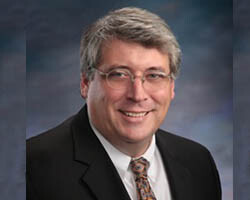
Rev. Dr. Fred G. Garry
Senior Pastor & Head of Staff
Sermon Notes
You can add your own personal sermon notes along the way. When you're finished, you'll be able to email or download your notes.