To Dissipate

During the Third Reich, the German Evangelical Church became an extension of the National Socialists. Resisting this a "confessing church" was born and a leading theologian broke away forming an "underground" seminary. The underground seminary trained students not only in how to pastor a church, but also how theology could resist the power and influence of a national church under the sway of Nazis.
The theologian forming the underground seminary was Dietrich Bonhoeffer. Bonhoeffer is often remembered as a martyr being executed for his part in a plot to assassinate Hitler. Yet, prior to his arrest, imprisonment and death, Bonhoeffer wrote a small book, a kind of manifesto, called Life Together. Life Together was meant to be a guide for leading the church of the future.
I read this book as a college student, then read of all of Bonhoeffer’s books. All were poignant, insightful, but Life Together has a unique voice as it was written far from the ivory tower, far from the safety of the professor’s study; this was a living, breathing voice of how people could follow Christ together even if such a following was dangerous.
In the opening lines of Life Together Bonhoeffer gave a warning, a warning I still hear some forty years later. Quoting Luther, he warned of those in the church who seek to make of a congregation, shape a gathering of believers, transform them into something they imagine, a “wish dream” he called it. Don’t seek to shape the church into your “wish dream.”
Although it took me many years to fully understand his concern, this warning of wish dream shapes what I do each day. What I came to see is this: my job, my calling, my role is to help a church listen to their heart, hear what God is calling the church to be in this place. I am not here to share my vision of the church, to offer my plan for a what a church should be, nor even provide the definition of what a church is. Those visions, plans, definitions are in you, and to some degree us, but never mine alone.
Through the years elders have challenged this by saying, “just tell us what to do” or “what is your vision here?” There is always a temptation to just give directions or give my ideas, desires. But always there is the voice of Bonhoeffer warning future pastors, don’t give the church your wish dream.
Don’t half understand me, I have plenty of ideas and schemes and thoughts. And it is tempting to make of worship or a worship space what would appeal to me, be my design. But if I did the church would be an extension of me not the revelation of your heart.
Even more than temptation, though, was a recognition about myself and my dreams. It took me a long time to see and appreciate how small my dreams tend to be, how modest my ambitions. I am not one to play safe, and certainly not one to play within the confines of tradition, but I just don’t make big plans. Risk, yes; plans, no. Again, this took a long time for me to see and maybe it was born of Bonhoeffer’s warning about wish dreams, but my dreams tend to be rather mundane, much more cottage than castle.
Many years ago I enjoyed a year of therapy with a great therapist, Don. Don was such a help, a good counselor; he let me hear my heart, hear my struggle, and then hear my answer. On one occasion though he pushed back, offered some unsolicited critique. He asked me, “what is your dream, what is your vision of the future, what is your hope for yourself?” After I told Don my dreams, hopes he shook his head and said, “man, you got to get better dreams. They are yours, true. But you need to hope more, dream better.”
Since this conversation I have tried and mostly failed to change this. I am more hopeful, more open to bigger dreams, bigger plans, but not much. Our capital campaign is a great example of this. It was not my idea to renovate the chancel; not my prodding to set aside a portion of the preservation fund. I was excited about this and very content with the idea of renovating just this space. Yet, as the project grew and grew and grew, I will tell you as I have told the leaders of the campaign, this is bigger than my vision. All good, all needed, all right things to do, but so much more than I would have planned, envisioned. This is truly your plan, your calling, the Holy Spirit moving you as a church.
On your bulletin cover is an apsidal chapel in the chevet of San Denis, the basilica just outside of Paris. The altar and stained glass serve as the devotional station of a monk or priest for their daily performance of the Mass. There is roughly a dozen of these surrounding the high altar each accessible from the ambulatory. This window is the beginning, or birth, of Gothic design.
In 1142 the abbot, Abbe Suger, introduced this new window design. His plans were influenced by the early church mystic Dionysius, or pseudo-Dionysius as he more often known. At once practical as well as daring for its extravagance, Suger's introduction of a place of devotion immersed in light and color and proportional harmony changed the world. From his design sprang more than 150 cathedrals and even more great churches and parish churches all seeking to capture the beauty of San Denis.
This last April I visited more than twenty of these churches. Again and again my eyes were drawn to the rib vaults and clearstories where the massive stone walls seem to evaporate, become thin and delicate. On several occasions I was lucky to visit a cathedral when the light was just right. Usually around eleven in the morning. The sun light would take the colors of the stained-glass and paint the opposite wall or floors. On your bulletin cover is such a moment. Often I would take a seat and ponder what it may have been like to be a priest in the twelfth century, kneeling at the apsidal altar reciting the Mass only to become covered, bathed in color. I imagined what it must have been like to look at your white robe now painted by colored light.
During most of these visits at some point I would ponder my timid plans, the modest ambition of not quite big enough dreams and I would pause and wonder, what it must have been like to be Suger, to say, let us build a space so wonderful, so transcendent, so beautiful it would inspire the world for centuries. Let us bring light from stone; let us bring heaven to earth.
When I consider our plans and projects for this sanctuary, I am mindful they are not a neo-Gothic explosion of pointed arches and quatrefoil, and ceilings painted a deep blue with gold stars. We are replacing the windows, but there are no commissions for stained-glass medallions depicting the life of Jesus or the adventures of the saints, heroes of the bible. Our only nod to statuary will be a display of organ pipes. Our plans are very different from the birth of Gothic design. And yet we do share a hidden key.
The chevet at San Denis may have found a champion and an instigator in Abbe Suger, but the basilica he amended with Gothic design would continue to be constructed long after him, and the 150 other cathedrals all drawing from his beginning would take centuries to complete. Herein lies the key: the beauty of the work, the dream, vision, was the heart of the people. If Suger’s design had been only his wish dream it would have faded as an ill-suited anomaly. But it was not. It was just as we are creating, a common hope, a community of faith, not the will of a pastor or priest.
As I mentioned at the onset of these five sermons, our readings from Luke are not the standard stewardship campaign, capital campaign fare. The little apocalypse of Jesus is not a call to generosity like the story of the widow’s mite; the wars and rumors of false prophets have no connection to Paul’s call for giving from a generous heart. We are not reflecting on Solomon’s construction of a temple; we are reflecting on the walls of Jerusalem falling seventeen times. I asked the campaign chairs to trust me, trust somehow amid these murky readings a light would come forth, a beautiful image would supersede the darkness and the gloom of the little apocalypse.
In this our last reading there is a double challenge. Not only is Jesus speaking of risk, threat, danger, but he is also speaking of despair, sadness, weight of worry, need for vigilance when hard times seem to be lurking in the shadows. And, while perhaps not the most timely message in a moment of celebration, and we should be celebrating today for we are so very close to reaching if not surpassing our bold goal, while it may not be timely for us, the weight of dissipation is key to our efforts, key also to the time we live in.
Dissipation, a word I have never heard in a sentence, dissipation is a Latin word chosen by the translator, an obscure word to match an obscure Greek word, for this is the only time the image of a scattered life, a life in fragments, dissipated life, is spoken of in the bible. Dissipation is not a word we use but it is a world we see. How can we not miss the tattered lives, the broken lives, the temptation of despair in addiction, the voices who say, “I feel forgotten” or “I feel invisible.” How often have you heard people speak today of being powerless, or life being pointless, without purpose.
In our reading today, Luke, and only Luke, places a call for courage and vigilance at the end of the apocalypse, a call to watch, be sober and do not fall to the worries of the world. Only Luke records this warning. Again, it may not seem a fitting reading for the moment, but I believe of all the readings from the apocalypse, of the five, this one is the most important. It is because it speaks the great hope, our hope, for years to come. Amid scattered, dissipated lives, hearts in tatters, in a world where dystopian visions are popular and prevail, in the darkness we have chosen to build and bring light, more light, a light to overcome the darkness for years to come. Amid so much cynicism, we chose hope.
Wendell Berry captures this hopefulness, he writes,
Invest in the millennium. Plant sequoias.
Say that your main crop is the forest
that you did not plant,
that you will not live to harvest.
In a moment where time is flying past and the rise of artificial intelligence is looming with a specter of technological apocalypse, we have chosen to renew, remake our pipe organ, we will not cast away the pews of centuries, we will simply get a new cushion. Instead of raising our pulpit higher, we are bringing it down to earth. In a time where so many call for the rule of the sword, where might makes right, we are removing barriers of exclusion so all may find a place of glory here. The only ability required is an open heart.
Instead of cowering we are bold in our faith and hope for years to come. This is the true success. What you heard in your heart, what you could see and believe and thus make for generations. Let us revel today in the gift, the courage we are planting. Here future generations will live because we gave our life. Amen.
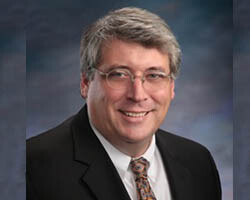
Rev. Dr. Fred G. Garry
Senior Pastor & Head of Staff
Sermon Notes
You can add your own personal sermon notes along the way. When you're finished, you'll be able to email or download your notes.